Mozambique Island - 1 Week Itinerary
- Katlyn and Paul
- Jan 3, 2018
- 6 min read
We only had one week on the actual Island of Mozambique, but if you have more time take it! I definitely think I could have spent more time swimming in the beautiful teal waters of the surrounding islands, filling my belly with fresh sea food, and learning about the deep history of the slave trade that happened here.
In this post we are going to outline our one-week itinerary for traveling around Mozambique Island just in case you also decide to take the journey yourself.
Explore the Island by Bicycle
When you first arrive at a new destination, we think it’s important to get the lay of the land and explore your surroundings. One great way to do this is by going on a tour. When we visited Mozambique Island, we opted for a bike tour with Ilha Blue (http://ilhablue.com/). After a bit of research, we found that this is one of the most environmentally ethical tour companies on the island. They have the added advantage of being one of the only tour groups as well…
We met with our tour guide around 9:00am at Ihla Blue to get fitted to bikes provided by the tour company. Our guide was a Mozambique Island local, had great English, and was very knowledge about the island.

Mozambique Island is currently and historically separated into two main parts: Makuti Town and Stone Town. Ilha Blue is located almost exactly between the two areas, so we started our tour from there, circled the entire island, and ended back where we started. The whole tour took the better half of the morning.
On our first stop of the tour, we rode to a Hindu Temple and went inside to meet with a Brahman. Although we couldn’t speak Hindi, he welcomed us by using gestures to show us around. While there, we saw a sacred tree, a few Hindu shrines, and also received a hard sugar crystal to eat…though we are still not really sure why. Ilha Blue suggested that it was appropriate to make a small donation to the temple as we were leaving, to thank the Brahman for taking the time to be with us.
The next major stop was a part of Makuti Town where a majority of Mozambique Island’s population live. The villages there are located in a space that was dug out by slaves to build Stone Town when Arabs still held the island. Our guide had us get off of our bikes and walk into the village, which made us feel uncomfortable for a few reasons. First, we were wearing shorts which, as we know from our time in our Malawian villages, might be seen as inappropriate since women in the villages usually wear longer skirts. We also were walking right through areas where people live, which felt invasive. The history we received about Makuti Town during this part of the tour was very informational, so if you are planning on doing this tour we would suggest to ask your guide not to walk through these people’s communal area, but to still have him/her explain the history. To us, walking through these people’s homes seemed exploitative of the Mozambicans living their daily lives there. However, despite feeling uncomfortable, everyone we met was very kind.
Our guide then took us through a few local markets, which were colorful, lively, and full of people. We reached a hospital built by the Portugese in 1877 and learned that for a long time it was the largest hospital in Sub Saharan Africa. Though it’s a far cry from its original pristine neoclassic finish, it is still a beautiful and functional structure to this day.
When we reached the southern end of the island, we stopped for a short break at a stand alone white church called Santo Antonio that seemed to be nearly surrounded by the Indian Ocean. Near the church was a cemetery that is the resting place to Muslim, Christian, and Hindu individuals. Also nearby was the only bridge that led to the mainland. This three and a half kilometer-long structure was built over the Indian Ocean to the island in 1967.


Our tour continued back around the island to Stone Town, where we rode past many restaurants, lodges, Mozambique Island Museum, Fort of São Sebastião, and through alleyways surrounded by old, beautiful stone buildings. Read more on that below!
Eat Good Food
Throughout the trip we tried almost every restaurant Mozambique Island had to offer, which although isn’t a long list, can keep a traveler busy. Each had its own flair, price, and view. Ancora D’Ouro is an Italo-Mozambican restaurant located across from The Church of Mercy in Stone Town and was by far the restaurant we visited most. Prices ranged from about $4-$12 depending on the plate, but every meal was exceptional. With its white walls, wooden tables, and revolutionary-esk photos on the wall, Ancora D’Ouro may offer the best food in town. It has indoor and outdoor seating.
For a traditional bite to eat, Sara’s offered the best priced and tastiest local cuisine on the Island. Located at the intersection of Mukuti Town and Stone Town not more than 50ft from the hospital, Sara’s should not be missed.
If food is a big part of your reason for travel, also check out my post Where to [and NOT to] EAT, all about food on Mozambique Island.
Visit the Governor’s Palace Museum
There’s a lot of things I’d say a traveler to Mozambique Island can’t miss, but if I can impress anything on my readers, the Governor’s House is a MUST. While some visitors to the island may not agree, the only question I’d have for them is, “Who was your guide?” When visiting any historical site, guides may be the most make or break part of the experience. Our guide for the Governor’s House was James, and he was exceptional. Throughout the tour we received a deep, tragic, and rich history of the island seen from the place where it was ruled. The building was originally built in 1610 as a Jesuit Catholic College. Then in 1759, the Portuguese Governor of Mozambique moved from Fort São Sebastião to the college, making it his new home. Astonishingly the Portuguese King had his own room and living room in the Governor’s house, but never came to visit. It would serve as the Governor’s home until 1898, when the Governor moved to Lourenço Marques (now Maputo, the capital city) and the building turned into a guest house for visiting dignitaries. Finally in 1975, after the revolution, the guest house became The Museum of Mozambique Island.



Take a Tour of Fort of São Sebastião
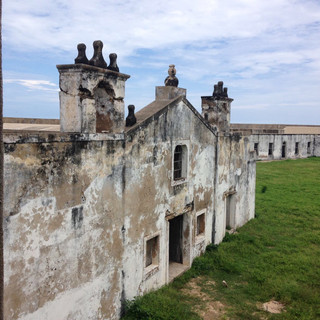
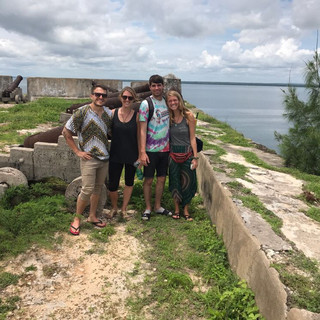
Fort of São Sebastião was one of the few Portuguese forts on the African continent that was never conquered by foreigns powers, despite multiple attempts. It lies on the northern most point of the island next to Chapel of Nossa Senhora de Baluarte - which is actually the oldest European building in the Southern Hemisphere - built in 1522. The Fortress’s size and complexity with a water reservoir and drainage system was impressive even by today’s standards. However, like most building on the island, its history and construction was less a symbol European labor and more a display of slavery and colonial subjugation.





Jump On a Boat to Goa Island
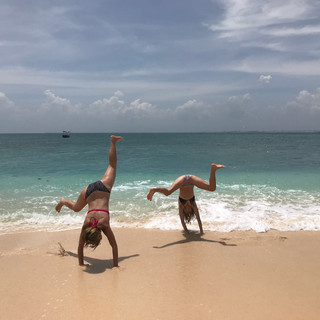
When walking by a sign that says, “Harry Potter Tours,” in ‘Africa’, what millennial wouldn’t stop in to at least check it out? Harry Potter Tours is run by a Mozambican Rasta man who locally goes by Harry Potter, and provides budget day trips to surrounding islands. For a beach goer, Mozambique Island itself doesn’t offer much, but only a kilometer boat ride away you’ll find some of the most beautiful beaches in the region.
We went to Goa Island with Harry Potter’s tours. Included in the trip was snorkeling, lunch, and laughs. Sadly a lot of the coral was dead, but the snorkeling on the island still had a decent diversity of fish for viewing. I’ll also say that HP’s friends cook a mean fish, rice, and tomato sauce for lunch. After spending a couple of hours swimming and eating on Goa Island, we went to a lagoon on a different beach- which although the visibility wasn’t great, offered a unique experience. The trip finished in the late afternoon, with a dhow ride, our backs red from sunburn, and a gorgeous sunset.


Chill, Enjoy, and Play Settlers of Catan
No matter how you spend your time on Mozambique Island, there are numerous alleys, walkways, and streets that seem to transport the visitor back in time. Visiting the parks and palazzos simply astounded us. If you find yourself spending a day doing nothing at all, but walking around, viewing the buildings from a lone balcony, sitting on a bench, or playing Settlers of Catan with friends, fret not, as that may be your best day on Mozambique Island.

Comments